An
Island Safari Tour |
|
Long time local, Sweeny
Toussant, greets me and a small group of visitors in his open-air bus. We
are ready to explore the wondrous places of St. Croix. Sweeny, his Safari
Tour, and the bright red tour bus are well known icons on St. Croix. Sweeny
points out the highlights of the Christiansted Historic District as we head
North to our first stop, the St.
Georges Village Botanical Gardens. Here history and botany abound. |

All aboard for Sweeny's
Safari Tour. |
Flowering
trees, shrubs, and vines are nestled among the ruins of an eighteenth
century sugar plantation. Sweeny tells us of the Arawak Indians that had
settled at the grounds long before it was a Danish sugar plantation. Both
peoples and their presence on the land has made the property a historic
place, not once, but twice in the National Registry of Historic Places
in Washington, D.C.
As we walked the grounds, Sweeny explained the names of the
flora and fauna, as well as their origin, and medicinal or culinary
uses here in the Virgin Islands.
One tree that
captured the group was the Ylang Ylang, or Perfume Tree; its flowers are
often sought for their delicate scent and perfect color. Another enchanting
species at the gardens was the mystical “Love Bush,” an easy to grow,
tell-all plant. |
Throughout
the Caribbean islands, it is thought that the Love Bush, not the daisy,
answers whether he loves you, or he loves you not. Sweeny picked a fallen
leaf, gave it to one of our group members and tells the legend. :This plant
is so easy to grow. You can take this leaf and just lay it on top of some
soil. Soon you will notice sprouts from each node on that leaf. If you don’t
see sprouts, go talk to your husband. Somebody is fooling around."
|
 |
I followed the group
toward the exit, making a brief stop at the garden’s wedding arch for
a few pictures.
We boarded the bus
for a short ride to our next stop, the famous Cruzan
Rum Distillery. One of the distillery’s guides took over and explained
with pride how one of the world’s finest rums is produced, bottled and
distributed throughout the Caribbean and United States right here from
St. Croix. |
 |
| 
Cruzan Rum is one of the top rums
in the entire world! |
After
touring the distillery, we were lead to the warehouse where thousands
of hand crafted American oak barrels are stored. The rum filed barrels
lay on their side on racks made from 19th century Virgin Island railroad
tracks. Here they are left alone to age for a minimum of two years; some
for twelve or more years.
After watching how
Cruzan Rum is bottled, labeled, and shipped, we were taken to the guest
pavilion where we tasted the finished product and purchased some as souvenirs.
Black and white photos of the distillery from centuries ago hang proudly
on the walls, reiterating the long and productive life of the Cruzan Rum
Distillery. Still tasting the ambrosial rum on our tongues, we head back
to the bus and down the road to Whim Plantation. |
 |
|
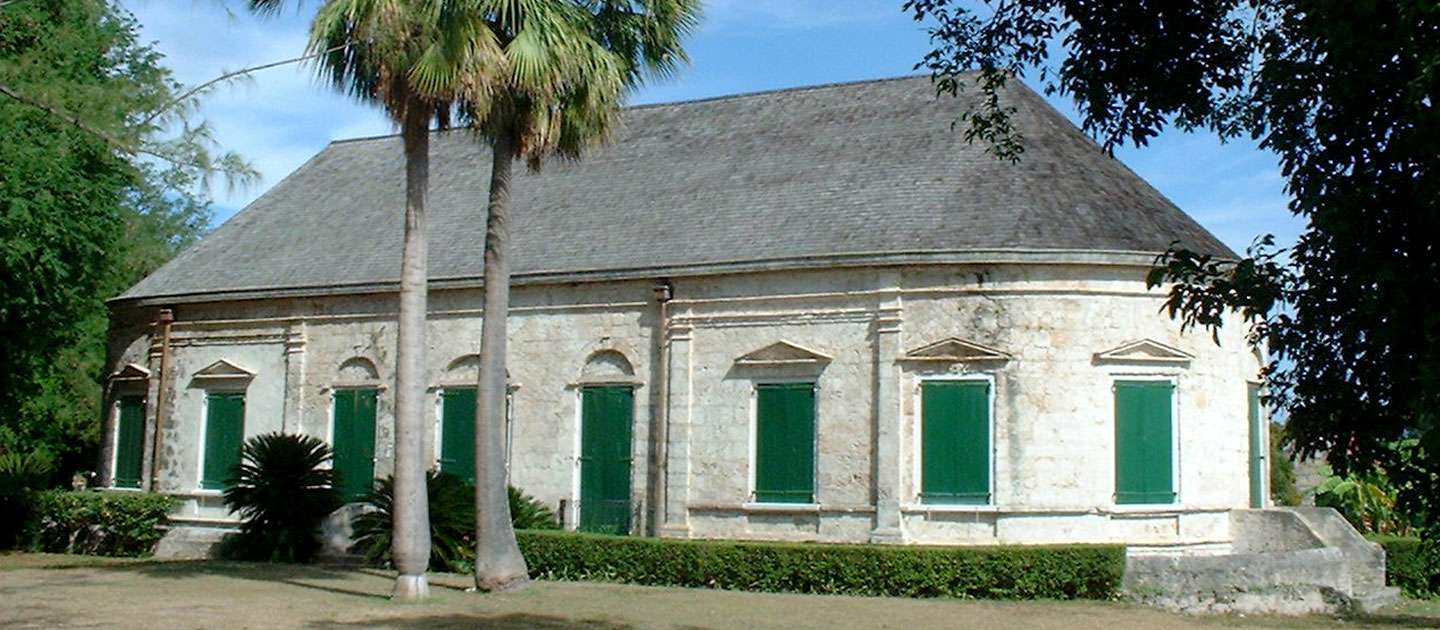
Here, a large 18th century
great house, built with coral and stone, is bonded together with mortar
of shells and sugar molasses, standing firmly on the site of what once was
a Danish sugar plantation. |
 |
It was
either Sweeny or my stomach that said, “The best way to learn is to be hungry
for knowledge.” I am pretty sure it was my stomach but with out further
delay, Sweeny told us he would be calling ahead to one of his favorite delis
for our lunch. |

Whim Plantation Museum |
He
took our orders and we were on our way west to Frederiksted. Once at Frederiksted,
we stopped at a seaside deli in Prince Passage to have lunch. We enjoyed
our sandwiches in the shade at the water’s edge, with views of passing ships
and elegant sails dancing across the turquoise water. After lunch, we followed
along the coastline on Strand Street and our tour turned into a lesson "en
Danske". |
The Danes not only
had an influence on St. Croix’s economy with the production of sugar cane
but also on the architecture and urban development, prominently seen in
Frederiksted. Strand Street, for example, when translated means Beach
Street.
 |
 |
Frederiksted
offers many historical attractions, such as Fort Frederik and prominent
architecture. |
A turn off the coast
takes us through a labyrinth of one-way streets and allows us to see the
grandiose historical churches in Frederiksted, as Sweeny provides insight
into the many different religious groups that sought religious freedom
here in the islands. The Moravians for example, were persecuted almost
everywhere they formed so they found themselves here in search of solace.
We continued through the streets, and found ourselves in front of Fort
Frederik.
We were told why Frederiksted
is respectfully called Freedom City, why the towns of Christiansted and
Frederiksted have significantly different architecture and what roles
the slaved played in the architectural changes- a fire caused by rebellion,
a demand for freedom. |
We continue along the
coast until we reach Mahogany Road, which lead us into the tropical forest.
Sweeny pointed out the fruit trees that canopy the roadside and offer shade
and a heavenly fragrance. An unexpected stop at Mount Pellier’s Domino Club,
home to the beer drinking pigs, invigorates curiosity. |
 |
We gathered
at the bar to find Norma, the Domino Club’s owner, and inquired about
the beer-drinking pigs. She handed us non-alcoholic beer and sent us to
a large pen where we found two extremely large and very thirsty pigs standing
on their hind legs, begging for another kind visitor to hand them a beverage.
With the pigs refreshed
and happy, we again approached the bar, this time to inquire about the
Domino Club’s two other specialties, Mamma-Wanna and Babash. Babash is
a moonshine drink that will knock you off your…well, let’s just say it
is potent, and stays with you for days. The Mama-Wanna on the other hand,
is a little kinder on the taste buds. It is just as effective as the Babash
but this spicy concoction is made with herbs and has plenty of flavor. |
 It's
hard to say who’s more excited, the pigs or the onlookers as the pigs throw
their heads back, crush the can and chug beer like a nineteen year-old frat
boy. |
 |
A light
drizzle of rain suggested to us that we continue along. From Mahogany Road,
we cut over to Rte. 69 to catch a glimpse of the Carambola
Golf Course. Carambola’s eighteen-hole golf course, designed by Robert
Trent Jones and built by Laurence Rockefeller, is the proud recipient of
Golf Magazine’s Gold Medal Award. Even if you are not a golfer, you will
still appreciate its beauty as well as the many species of birds, turtles,
and other critters that have made this golf course their home. Rte. 69 continues
over Parasol Hill, affectionately referred to as “The Beast” by our visiting
triathletes, because of its incredibly
steep incline. |
 |
 |
Once at the bottom,
we find ourselves on North Shore Road, which follows along the coast,
offering picturesque views of rolling hills and the Caribbean Sea. We
continued along the north shore to Salt River and Columbus Landing.
Sweeny pulled over so we could snap a few pictures and told us about
Christopher Columbus' landing in the Salt River Bay in 1943.
We continued along
the road, and as Christiansted came into view, I knew our tour was coming
to an end.
In just a few hours
I have gained a new appreciation for the places I went today because
of Sweeny, our well-informed tour guide. Sweeny’s
Safari Tours combines history, politics, religion, education, cultural
traditions and botany with a bit of comic relief to offer visitors to
St. Croix an experience not to be missed!
|
 |
|
What to bring with you on a Sweeny Safari Tour:
1. Plenty of water
2. Comfortable walking shoes
3. Camera
4. Wear sunscreen and bring extra just in case
5. Gift shop money
6. Umbrella for our short, unexpected showers
This tour is perfect for kids of all ages!
|
Article
written by Leslie Hillyer, Photos © www.gotostcroix.com |
|
|