
Learn about the medicinal and practical uses of our most common plants. Read about the importance of our agricultural products, and realize how they have not only shaped our lives, but our economy and culture as well.

Trees- Turpentine Tree

Turpentine Tree This tree can grow to 40 feet or more living wildly in deciduous woods, or as a cultivated ornamental. It is native to the West Indies, Central America, and South Florida where it is known as the Turpentine tree. Cruzians, on the other hand, prefer to call it “The Tourist Tree” because the [...]

Trees- Sandbox

Sandbox Nobody, including monkeys, would attempt to climb this tree. In fact, locally, it is better known as the Monkey-No-Climb. Its yellow-gray bark is covered with short, squat, fleshy spines. When we say covered, we mean covered! Though native to the West Indies and Central America, this tree can be found in our rainforest, many [...]

Trees- Seaside Mahoe

Seaside Mahoe The seaside Mahoe looks very much like the Manchineel. A good way to tell them apart is by the leaves. The seaside Mahoe has green, heart-shaped, 4- to 5-inch leaves with tapering tips. Solitary, 2-inch long, cup-shaped, hibiscus-like flowers begin yellow but turn red before falling. Flowers are produced year round. The fruit [...]

Trees- Manchineel

Manchineel Usually found near the beach, offering wonderful shade and golden apples, the Manchineel tree is very dangerous! Columbus recorded the first record of its poisonous nature, after his men had died after their encounter with it. One should not picnic under it or handle the broken vegetation. The sap can cause permanent blindness if [...]

Trees- Powder Puff

Powder Puff Tree (Calliandra inaequilatera) This majestic tree, native to the West Indies, can grow to more than 75 feet. Leaves are found in 3 to 10 pairs of shiny, stiff, glossy leaflets, each about 6 inches long, with a gently curved mid vein. It bears a hard wooden, green then brown, pear-shaped fruit, which [...]

Trees- Mahogany

Mahogany This majestic tree, native to the West Indies, can grow to more than 75 feet. Leaves are found in 3 to 10 pairs of shiny, stiff, glossy leaflets, each about 6 inches long, with a gently curved mid vein. It bears a hard wooden, green then brown, pear-shaped fruit, which splits into 5 segments [...]

Trees- African Tulip Tree

African Tulip Tree The major attraction of this Kenya native are its large softball-sized bell-shaped orange-red flowers with a yellow border on the petals…huge and spectacular. There are also referred to as Fire Tree, Flame of the Forrest or Fountain Tree. No matter what you call it, it is a showy site to see!

Fruit- Tamarind

Tamarind (Tamarindus indica) The leaves of the Tamarind tree are alternate and plentiful, giving it a light green feathery look. They are each 1 inch long with parallel edges. Lumpy green, then brown round pods also fill the trees, an inch in diameter and varying in length. The bark is rough. Tamarind is native to [...]

Fruit- Soursop

Soursop (Annona muricata) By the looks of this fruit, you may not want anything to do with it, but it is actually quite tasty! The inner white flesh is a sweet pulp that is used to make juice as well as candies, sorbets, and ice cream flavorings. it is believed that the leaves of the [...]

Fruit- Sea Grape

Sea Grape (Coccoloba uvifera) Found by the sea and safe to use for shade, the sea grape can also be eaten when ripe. The leaves look like fans and can be used as such. Flowers are closely spaced and radiating at right angles from a stem that starts out erect but later hangs as fruit [...]

Fruit- Papaya

Papaya A papaya tree can be spotted by its soft, greenish and hollow trunk topped with many spiraled, umbrella-like clusters of large leaves bearing pear shaped fruit. In the wild, papaya trees are either male or female. Occasionally, the male plant will bear flowers setting into fruit but usually the female bears the fruit. Plants [...]

Fruit- Mango

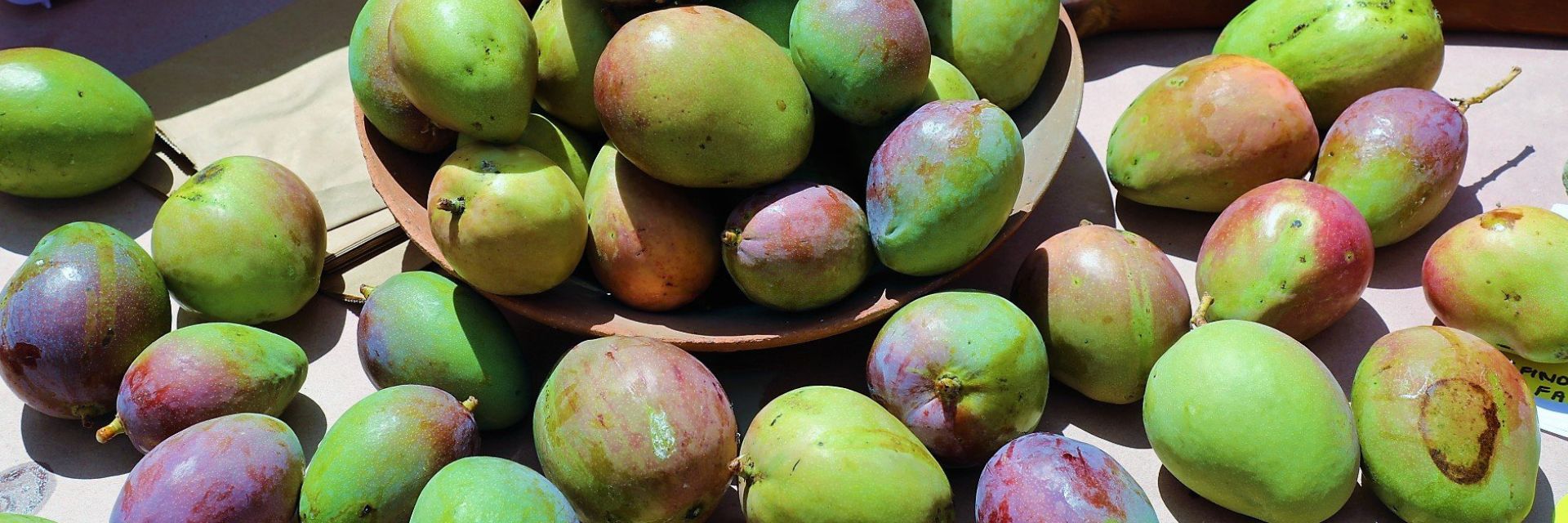
Mango (Mangifera indica) Though there are several types of mangoes, each one is sweet, juicy, and refreshing. The leaves are simple, alternate, and clustered at branch tips. They are narrow, pointed, glossy, short-stalked and about 12 by 3 inches. Mangoes are oval, often lop-sided and hanging green and then ripen to red, orange, purple-brown or [...]

Fruit- Kenip

Kenip The Kenip tree is large with a usually straight trunk with many branches bearing many oval shaped leaves. It’s fragrant flowers grow in clusters at branch ends. The male and female flowers usually appear on separate trees. Also found in clusters is its round fruit covered with a green leathery skin and edible pinkish [...]

Fruit- Carambola

Carambola (Averrhoa carambola) More commonly reffered to as a Star Fruit (yes, really!) these juicy golden drops of sunshine can be found growing on trees several months out of the year. The entire fruit can be eaten, except the seeds. They have a sweet taste to them, but can be bitter if over ripe. The [...]

Fruit- Breadfruit

Breadfruit (Artocarpus communis) The beautifully lobed leaves and impressive green fruits of the breadfruit are easily recognizable in the Caribbean, and their quiet cultivation belies the tumultuous history of its origin in these parts. Originally from Tahiti, the breadfruit is often claimed as one of the reasons behind the mutiny on the Bounty, which figures [...]

Fruit- Banana

Banana (Musa spp) Originally from Southeast Asia, now grown in over 107 countries throughout the tropics. Though most people are familiar with the popular store variety, the Cavendish, few realize the variety that bananas come in, until traveling to the tropics. Eaten ripened (yellow) or cooked when green, bananas can be sweet or savory and [...]

Fruit- Avocado

Avocado (Persea americana) Also called “Pears” in the Caribbean, the mild-flavored avocado has a saucy nomenclature. Derived from the Nahuatl people (traditionally referred to as “Aztecan”) of Central Mexico, their word for avocado, ahuacatl, translates literally to “testicle” a reference to the shape and texture of the fruit. Eaten for fertility, or avoided in efforts [...]

Plants- Tan-Tan

Tan-Tan This prolific plant can be found almost everywhere on the island… on roadsides, open fields, woodlands, even inside houses growing like a weed beside your favorite house plant. It grows fast and thick, starting as a small twig and eventually, if left alone, can grow to a great size. It’s branches are covered with [...]

Plants- Century Plant

Century Plant (Agave americana) The century plant resembles an Aloe plant, except it is much larger and possesses sharper spines on the leaves’ edges and its pointed tip is sharp and strong. Until flowering, each plant has a single stem bud which produces leaves in clusters near the ground. When the plant has stored enough [...]

Plants- Casha Bush

Casha Bush This very intimidating thorn-covered bush is seen almost everywhere on the island. Its leaves are numerous, each about ¼ inch long and blunt tipped. Casha also holds cylindrical tiny yellow flowers and a nearly cylindrical legume pod, 4 to 5 inches long. The stem is thin and woody, usually contorted and covered with [...]

Plants- Cactus

Cactus (Echinocactus grusonii) Many different types of cacti are present throughout St.Croix, mostly on the dry terrain of the East End. The “prickly pear” (a) can be found throughout the island. Many use it for it’s decorative properties. This particular cactus possesses jointed stems formed of flattened segments covered with hairs. The flowers are yellow [...]

Plants- Aloe

Aloe (Aloe vera) Originating on the Mediterranean coast of Africa, Aloe thrives in climates such as the Caribbean as well as Central and South America. It has large, fleshy, strap-like leaves close to the ground edged with spines and a pointed tip. In the Virgin Islands, the external uses are numerous. It is used as [...]

Fauna- Iguanas

Iguanas Look in trees, mangroves and scurrying across the road for this pre-historic looking reptile. Iguanas are native to the Caribbean where they like the sun and warm waters just as much as you do! Babies are brightly colored and FAST! Adult males can be dark green or blue and can grow up to six [...]

Flora- Plumbago

Plumbago ( Plumbago capensis ) Also called Leadwort because of its lead colored roots. Plumbago can be found growing wildly along the roadside or in planters around the island as decoration.In clusters among simple, elliptical leaves, the flowers are a light blue or lavender color. Each flower is 5 parted, long and tubular, with a [...]

Flora- Hibiscus

Hibiscus ( Hibiscus spp ) Because of its great beauty and hardiness, the Hibiscus has become a well-known and well-loved plant. It may be the official flower of Hawaii, but the Hibiscus can be seen in the Virgin Islands growing wildly along the roadside, or elegantly covering a window by someone’s home. Its presence is [...]

Flora- Ginger Thomas

Ginger Thomas (The USVI Official Flower) Native to tropical and subtropical America, Texas, New Mexico and Florida, this beautiful yellow flower can be found thriving year round on St. Croix from hillsides and thickets alike. Ginger Thomas is so abundant that it is considered our territory’s flower. Not only is it a pleasure to look [...]

Flora- Frangipani

Frangipani ( Plumeria rubra, Plumeria acutfolia ) These beautiful flowers are most commonly seen as white with a diffused yellow center, or bright pink with a yellow to orange center. The flowers grow singly or clustered among narrow to broadly elliptical leaves. The basic branching pattern of a frangipani look like ‘Y’s. Today, the Frangipani [...]

Flora- Cup of Gold

Cup of Gold (Solandra nitida) Cup Of Gold is a beautiful bright yellow flowing plant that can grow up to 40 feet tall! This vine can be extremely invasive if not kept in check. The blooms are amazingly large at 5-7 inches wide and 9 inches deep. Also reffered to as a trumpet flower.

Flora- Crown of Thorns

Crown-of-Thorns (Euphorbia splendens) This tropical plant came all the way from Madascar. Its blooms are mostly red and its thick stems are covered in thorns. Cuttings from this plant can be stuck directly in the soil and grow with out an existing root system. Mosty, you’ll see this bushy plant in pots as ornamentals.

Flora- Bouganvillea

Bougainvillea ( Bougainvillea spp ) With many varieties and colors, it is no wonder that this bush is seen so often. Colors range from a dark red to a subtle white. Leaves are small, elliptical, and become narrow to a point. Flowers grow in clusters of bright color, excluding the white for obvious reasons, and [...]

Flora- Bird of Paradise

Bird of Paradise Flower( Strelitzia ) Do you see the resemblence? This flower is actually native to South Africa, where it is also known as the crane flower. The species was brought here because of its beauty and its ability to do well in our warm, humid climate.

Eco-Tourism on St. Croix

St. Croix is unique in the fact that we are still considered “undiscovered.” We are not over-run with tourists and you can still find quiet, out of the way places, just like the Caribbean should be! We get a “different” type of guest who does their research, wants to stay and explore our hidden treasures, [...]

Recycling on St. Croix

Great, great news Crucians, can recycling is back on island! I know that I always feel a twinge of mental anguish everytime I throw a can in the garbage, but we haven’t had any on island options for recycling until now. The Boys & Girls Club, in addition to all the great work they do [...]

The Coconut Diet

My husband, away for two weeks, has left me with 7 coconuts waiting to be cut open with our newly sharpened Machete.  It is a sight that fills me with pride and helps me sleep better at night knowing that if all else fails in the world, I have a tree full of coconuts to [...]